-
Exploring Classical Deployment Patterns: Dev, Test, Staging, Production
Exploring Classical Deployment Patterns: Dev, Test, Staging, Production The classical deployment pattern organizes application environments into distinct stages to facilitate systematic development, testing, and deployment. This approach ensures that software passes through several quality gates and validation steps before reaching the end-users in production. 1.… [ Read More ]
-

Private and Public IP addresses in Azure – Features and Use-cases
In Azure, IP addresses play a crucial role in the configuration and communication of resources within the cloud. Azure provides two types of IP addresses — private IP addresses and public IP addresses — each serving different functions. Understanding their features, use cases, and best… [ Read More ]
-

Learn about the detailed demonstration on Azure Alerts
To provide you with a detailed demonstration on Azure Alerts, let's walk through the process step by step. This will cover the creation, configuration, and monitoring of various types of alerts in Azure Monitor, including Metric Alerts, Log Alerts, Activity Log Alerts, and Service Health… [ Read More ]
-
Exploring Microservices Architecture in Azure
Exploring Microservices Architecture in Azure Microservices architecture is an architectural style that structures an application as a collection of small, independent services. These services are designed to perform a specific business function and communicate with each other through lightweight protocols like HTTP/HTTPS or message brokers.… [ Read More ]
-
Know about Continuous Delivery (CD): Its beyond Release Management
Know about Continuous Delivery (CD): Its beyond Release Management Continuous Delivery (CD) is an integral part of modern DevOps practices. While release management is a key aspect of CD, it represents just one piece of a larger system. CD encompasses the entire process of ensuring… [ Read More ]
-
Learning Path review questions: LP03
Learning Path review questions 01. How many deployment jobs can be run concurrently by a single agent? A single agent can only run one deployment job at a time. Each agent processes a job sequentially, so if you have multiple deployment jobs that need to… [ Read More ]
-
Exploring common release management tools in Azure DevOps
Exploring common release management tools in Azure DevOps Azure DevOps integrates seamlessly with various release management tools, making it a powerful platform for Continuous Integration/Continuous Deployment (CI/CD). Below is an overview of common release management tools and their features: 1. GitHub Actions GitHub Actions is… [ Read More ]
-
Examining considerations for choosing release management tools in Azure DevOps
Examining considerations for choosing release management tools in Azure DevOps When choosing release management tools in Azure DevOps, it's crucial to evaluate key factors that align with your development and operational workflows. Below are the primary considerations for selecting and configuring release management tools: 1.… [ Read More ]
-
Things to know about Release Notes and Documentation in Azure DevOps
Things to know about Release Notes and Documentation in Azure DevOps Release notes and documentation in Azure DevOps help teams and stakeholders stay informed about updates, changes, and progress in a project. Proper use of these features can improve communication, accountability, and transparency. 1. Release… [ Read More ]
-
Exploring how to measure quality of your release process in Azure DevOps
Exploring how to measure quality of your release process in Azure DevOps Measuring Quality of Your Release Process in Azure DevOps To measure the quality of your release process in Azure DevOps, it's essential to visualize your release pipelines, identify symptoms of a broken process,… [ Read More ]

Rajnish Kumar Jha, MCT: DevOps, Azure, Microsoft Certified Trainer
DevOps, Cloud, Azure resources & blog
Author: Rajnish Kumar Jha
Featured Courses

Rajnish Kumar Jha
MCT, MCSA, MCSE, MCAD, MCPD, MCTS, MCSD
My name is Rajnish Kumar Jha. I am Technical architect on Azure Cloud and .NET since 21+ years. I’ve worked for pioneer companies and as freelance trainer/consultant helping my clients to achieve their IT goals.
I find blogging, a great way to share back what I’ve learned all through my professional journey. You are welcome to connect or share feedback/suggestion here or through an email.
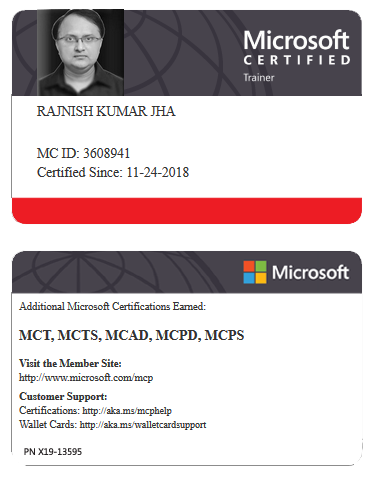
My MCT card (Microsoft)
My Certifications






Popular Posts





Stay Connected
Unlock the full potential of Azure Cloud with me
– Your trusted guide to Azure mastery!
SUBSCRIBE
My newsletter for exclusive content and offers. Type email and hit Enter.
No spam ever. Unsubscribe anytime.
Read the Privacy Policy.